Is Your Food Fit to Feast

Almost everything you eat or drink exists within the confines of modern-day food safety guidelines, standards, and laws. Before it enters the grocery store or restaurant kitchen (and later, your stomach), the raw materials and final product have most likely been tested, processed, manufactured, monitored, validated, quality-checked, characterized, and certified – all before being shipped to its final destination for consumer purchase. Here at BioInformatics and SDi, our analysts have found that the food industry and this lengthy process from farm to table is among the most prominent drivers of the analytical technologies market. As populations grow and demand for different food categories increase (think USDA Organic, non-GMO, gluten-free, etc.), the food industry’s contribution to the growth of instrumentation sales has even rivaled that of pharma/bio in recent years.
We explore this large and important market in-depth in our latest report: 2018 Testing Before Tasting: Analytical Instrumentation for Food Applications. Whether the materials being analyzed are in the form of processed foods, carbohydrates, meat, fruits, fish, vegetables, beverages, or ingredients, the need for accurate testing of food products, both for safety and quality control purposes, is at its highest. In this article, we review some of the recent and emerging trends within the food applications end market.
 One of the most talked about trends is organic foods versus foods generated using genetically modified organisms (GMO’s); as there is an increasing demand for both types of products. Both forms consider how crops are cultivated and matured. Organic crops (within the US) must be grown without any additives, without use of synthetic pesticides, or any genetic modification. Genetically modified crops on the other hand, have specific portions of their DNA altered in order to promote
  robustness in soil that may lack certain nutrients or even to survive herbicides intended to remove nearby weeds. Analytical tools —particularly life science tools—can be used to ensure that organic products don’t contain any trace pesticides, chemical additives, and so on.
Astonishingly, counterfeit foods are the fourth most lucrative counterfeit market. Counterfeit foods are fraudulent food products which are intentionally produced for economic gain and vary from opportunistic individuals to organized, large-scale operations. One product often under scrutiny is honey – where sugary syrups, such as corn syrup, are added into real honey to boost  quantity and profits. Counterfeit foods and beverages often pose significant safety risks to consumers, because these items may be produced without any regard for government regulations or acceptable safety assurances. Although governments continue to make food safety laws increasingly stringent, this practice is still on the rise. Here, advances in molecular-based “omics” technologies such as genomics, proteomics, metabolomics, and lipidomics, are being applied in order to authenticate food products and to detect counterfeiting.
Let’s say an item has made it all the way through the manufacturing and testing process and has made it to the grocery store. What’s one of the first things you might do when you take an item off the shelf? Check the label! Whether you’re simply looking at the ingredients, or trying to determine the manufacturing process (GMO/ grass fed/ free range  etc.), as a consumer you rely on an ethical and regulated packaging label to deliver the most accurate information. The demand for standardized labels is pertinent for our increasingly health-conscious consumer population and can even be a matter of life and death for those with serious allergies. Analytical tools can even be helpful for intelligent, or “smart,” packaging. For example, small sensors on packages can be used to indicate to both producers and consumers the current quality of food in terms of how fluctuations in oxidation levels can cause deterioration of nutrients in produce. The ability to monitor and understand these types of changes will allow for improved processes throughout the entire food supply chain.
So far, we’ve looked at how analytical instruments can contribute to specific areas of food testing. But what happens when something is neglected or not sufficiently tested, and we do consume contaminated food? I’m sure plenty of us have experienced the misery of food poisoning. However, contaminated foodstuffs can also contain viruses that can cause outbreaks over much larger populations. For example, approximately 6.5 million pounds of beef was recalled due to a Salmonella outbreak earlier this month. In addition to a large percentage of laboratories testing for foodborne bacteria, such as E.Coli and Salmonella, the use of metagenomics is increasing the efficiency in how foodborne outbreaks are monitored, diagnosed, and contained. This has implications in how food manufacturers can formulate action plans and increase their control over potential outbreaks, as well as enabling public health agencies to link cases of related foodborne outbreaks while enhancing surveillance and response times. Currently, 60% of foodborne illness is attributed to unknown causes, versus only 40% of which are causatively linked to 30 recognized foodborne microbes.
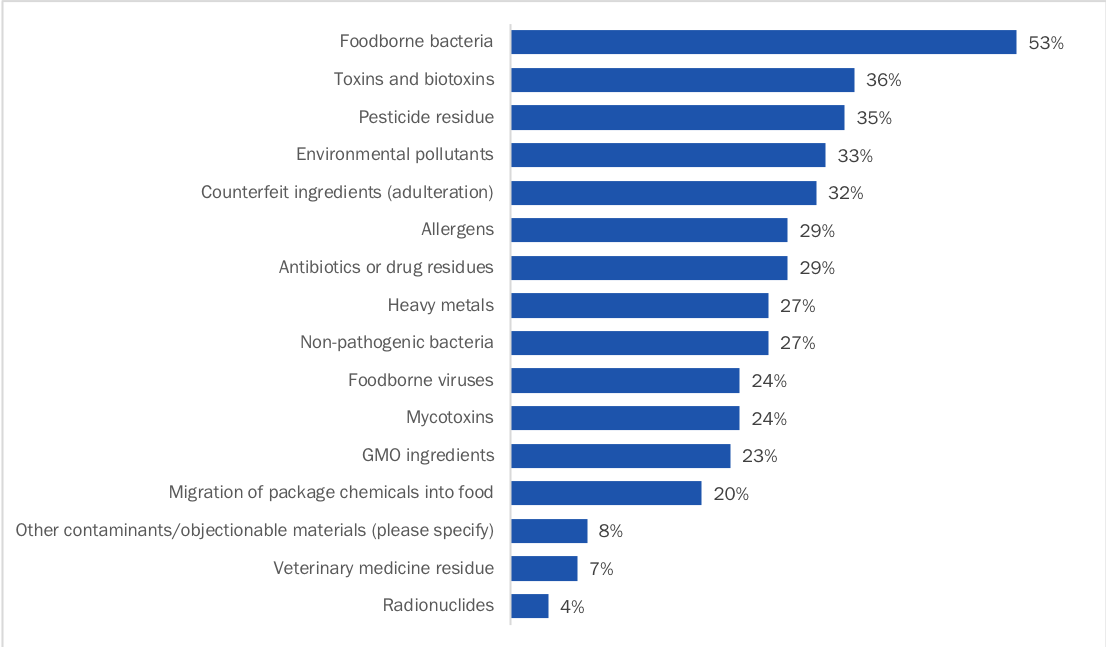
TYPES OF CONTAMINANTS TESTED (N=135)
Our next article of this series will cover more sample data and insights from scientists who use these technologies for food applications. With market size and demand data segmented by region, technology segment, and end market, our report, 2018 Testing Before Tasting: Analytical Instrumentation for Food Applications, is the perfect guide for management, marketing, and product development teams looking to strategically plan for 2019 and beyond. Please refer to our brochure for the report Table of Contents and additional sample data, or contact us directly with any specific questions.
Stay tuned for our last article!